Friday, July 12, 2019

Pre-Arithmetic Skills

Kindergarten
Pre-Arithmetic Skills
When learning arithmetic, students should start with simple skills. For example, in Kindergarten, students should count and write numbers daily, repeatedly do simple arithmetic combinations on a number line, such as 2 + 7 = 9, and use an equal arm balance to measure masses of objects. Other pre-arithmetic skills include the commutative rule (2 + 3 = 3 + 2), adding zero (6 + 0 = 2), adding one (11 + 1 = 12. The beginning exercises are simple and do not resemble later exercises (just as beginning piano exercises do not look much-advanced ones). 

On the number line, start with simple sequences of calculations: 
1 + 1 = 2, 1 + 2 = 3, 1 + 3 = 4, 1 + 4 = 5 Or 5 + 1 = 6, 6 + 1 = 7, 7 + 1 = 8, etc. OR 5 + 1 = 6, 5 + 2 = 7, 5 + 3 = 8, 5 + 4 = 9, etc. Do this rote training on the number line, again and again. When introducing larger numbers such as the teens, students should learn them as eleven: 10 +1; twelve: 10 + 2, etc. on the number line that goes from 0 to 20. 

Also, K-students should learn to read using Zig Engelmanns book (Teach Your Child to Read in 100 Easy Lessons).

Engelmann: "Only 10% of each lesson is new material. The remaining 90% of each lesson’s content is review and application of skills students have already learned but need practice with in order to master."

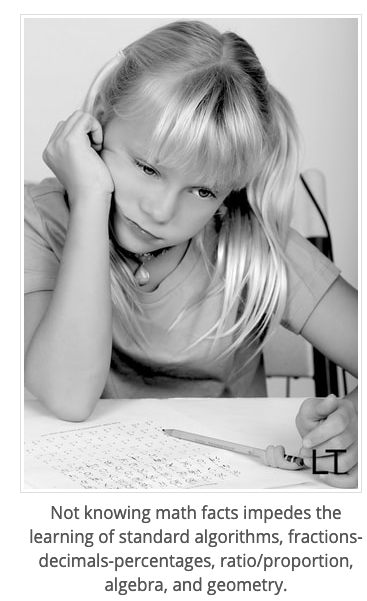
Teach Kids Algebra (LT)
I do not teach to the state test. I give lessons on pre-algebra skills, which puts stress on a student's cognitive effort. It's sensible but not always well received by some students who don’t want to think.  

Also, the school should abandon reform math and return to teaching basics—memorizing number facts, practicing the standard algorithms for mastery, recognizing patterns, and solving word problems by writing and solving equations. The problem is that the teachers don’t know how to teach math basics. Their skills are weak. They don’t know how to teach for mastery. They are told to teach the test, which is a “ bits and pieces” curriculum.    

In the reform math era, students are confused, and parents are baffled. Reform math stresses strategies, alternative algorithms, so-called mathematical practice standards, group work, and other extras,  Students are novices, not little mathematicians. They don’t think like adults. Novices require explicit instruction and a lot of repetition, practice, and review to learn something like arithmetic.  
2+2.png

We sent men to the moon using Newton’s Laws, a slide rule, and trig; today we send students to remedial math at community colleges using calculators and reform math. Even the state tests and the GED, AP, and SAT exams require calculators. Students are weak in arithmetic and don't know enough algebra. A whopping 87% of TUSD high school graduates who apply at Pima Community College (Tucson) are placed in remedial math classes. The math curriculum in Tucson and Arizona is not world-class. This is the case in most states. Common Core math is not world-class.   

There is no generalized thinking skill independent of domain content knowledge (E. D. Hirsch). But, many educators believe that there is a generalized thinking skill that can be applied to anything. It simply isn't true. Problem-solving (i.e., critical thinking) is domain-specific. Thinking in math is different from thinking in science, and so on.

Also, “understanding" does not produce mastery; practice does. Even our best students are below international benchmarks. "It's not that Asian kids overachieve; it's that American kids underachieve!" We should focus on the mastery of fundamentals like Singapore, not “learning” for a state test. But, we don’t. 

The way we teach math can block a child’s future. 
For decades, we have taught arithmetic poorly.  
The math I taught to 3rd graders in the early 70s was far different from what 3rd graders learn today. Today, students can’t calculate well, even though it is a key factor for problem-solving. You don't make drawings to do arithmetic. Who does that? It's another bad idea! Students should rely on memorized facts, fast algorithms, and pattern recognition to solve math problems. 

In general, U.S. Children are not mastering basic arithmetic. They are predominantly taught a version of reform math that downplays memorization, standard algorithms, and traditional instructional methods such as drill-to-develop-skill. Also, “state standards” are based largely on Common Core, regardless of the rhetoric from state leaders. CC math is not world-class, which puts our kids behind.

The main reason for our educational problems is "the teaching" in the classroom, but teachers, educators, and administrators don’t think that way. Educationists give excuses such as poor parenting, societal problems (e.g., poverty, drugs), and not enough money. The same excuses were given 50 years ago. "If we only had more money."

Even the best students complain that the reform math they are taught is confusing and overly complicated. Reform math is a hodgepodge of strategies and alternatives, not traditional arithmetic. Parents are baffled and can’t help their kids. Reform math is a hodgepodge of strategies and alternatives, not traditional arithmetic. The many alternative algorithms and so-called strategies take precedence over the standard algorithms. 

(Note. I call today's math "reform math," which stems from the 1947 NEA Yearbook and the 1989 NCTM standards. Reform math is promoted in Common Core and state standards and taught in schools of education.) Even in GATE classrooms, students are taught grade-level math, which is actually below grade-level at the international level. Our kids are behind, but no-one takes notice. We keep doing the same things, again and again, hoping for different outcomes that never happen.)

This is the status of many 4th graders. They struggle over the content they should have mastered in 2nd and 3rd grade but had not. Arithmetic isn’t taught for mastery. Memorization and practice-practice-practice and review-review-review have fallen out of favor in the progressive schools across America. Teachers use inefficient minimal-guidance methods and test prep. They are no longer the academic leaders in the classroom; they are facilitators, which is a radical change.

My 3rd Grade: 1971-1972 
In contrast, my 3rd graders (1971-1972), 28 of them, memorized the x-facts and practiced both the multiplication and long-division standard algorithms. They also learned fractions and parts of measurement and geometry. In addition to math, my 3rd graders had lessons in reading/phonics, writing/grammar, science, history, cursive, and so on. All students were expected to use cursive writing starting no later than December for spelling and writing assignments. The 2nd semester was long-division time. Incidentally, addition, subtraction across zeros, and place value were reviewed and extended in the first couple weeks of school. No manipulatives were used. Discipline problems in my classroom did not exist. It was a fun time, but hard work.

My algebra program (Teach Kids Algebra - TKA) has been in decline lately because it is linked to basic arithmetic. Students are not learning enough arithmetic. For example, they don't master multiplication in the 2nd and 3rd grade. The problem will persist as long as teachers focus on strategies and alternative algorithms (aka reform math), and use inefficient minimal-guidance methods (e.g., group work) and test prep instead of the explicit teaching of traditional arithmetic from the get-go (1st grade on up). 

Students need to memorize stuff and practice the standard algorithms starting in the 1st grade. Continual review is needed, too. 

Memorization is good for kids. 
Facts in long-term memory boost thinking and problem-solving in working memory.

Note. I taught and supervised the Talented & Gifted programs (TAG) at five elementary schools when I lived in Delaware. The TAG program was for the academically advanced and had stringent qualifications for admittance.  


The GATE program is mostly an enrichment program for bright students. As implemented at R/N, it is not for advanced math students or acceleration in math. Although some would disagree, GATE is not designed to improve an elementary student's achievement in specific academic areas such as math, reading, or science. Even the students in self-contained GATE classes get grade-level math for equity. Equity, which is a "fallacy of fairness," cannot produce equal outcomes (Thomas Sowell). “Equalizing downward by lowering those at the top is a crazy idea.”  


In contrast to GATE, my algebra program is focused on content. It does not pretend to teach children to be more creative nor does it stifle curiosity. It is not developmentally inappropriate as many believe. However, TKA does require children to use their cognitive abilities, but some bright kids don’t like that. Math is harder than other subjects because it is abstract. I have observed that some very intelligent students are weak in standard arithmetic


Another myth is the right brain/left brain. We now know that any cognitive activity goes through both sides of the brain, not favoring one side over the other. Also, there is no evidence for learning styles (Willingham). There are many common practices and theories in education that are not supported by scientific evidence.


Note. Kids aren't reading books this summer. They would rather spend much of their free time playing games, texting, or doing social media (Instagram, etc.) on their smartphones. Kids, today, are glued to screens. 


LT


Thursday, July 11, 2019

Preparing Students for the Future

Preparing Students for the Future!
It is common sense that if kids don't learn the fundamentals of arithmetic, then they are blocked from higher-level math (Engelmann).  The fundamentals start in 1st grade with the meaning of numbers by place value (e.g., 13 is 10 + 3), rules: add zero (3 + 0 = 3), add one (5 + 1 = 6), and commutativity: 3 + 4 = 4 + 3), memorizing the number facts, and learning the mechanics of the standard algorithms, first. Incidentally, the standard addition algorithm is the best model for place value and should be taught in the 1st-marking period of 1st grade. 

Content-free is the wrong approach!
Teachers are instructed to teach higher-level thinking skills (i.e., critical thinking or problem-solving) before kids had mastered the fundamentals that support content thinking. For example, learning basic arithmetic content starts with memorizing the number facts, place value, and practicing the mechanics of the standard algorithms for automaticity. Students should practice and review the basics to make them stick in long-term memory for use in problem-solving. Applying content knowledge is the next significant step. Recognizing problem types is critical in arithmetic and algebra.  

Robert Pondiscio (Fordham Institute) writes, "Hirsch, myself, and many others have long lamented the content-free, skills-driven, curriculum-agnostic brand of schooling that has come to dominate American primary education. This state of affairs is due in part to mistaken notions about how children learn." I do not blame teachers; they are doing what they had been trained to do, but I question "the teaching" itself.  Critical thinking (aka problem-solving) without content is empty. Thought is domain-specific. You cannot solve a trig problem without knowing some trig or translate Latin without knowing some Latin. In math, efficient calculating skills are an intrinsic part of problem-solving. Passing from one grade to the next does not mean the student is competent at grade-level arithmetic. More likely than not, most students are below grade level (NAEP math). It is common sense that if kids don't learn the fundamentals of arithmetic, then they are blocked from higher-level math (Engelmann). So what has happened to common sense? 

Thomas Sowell (Discrimination and Disparities, 2019) points out, "Education is an area in which differences in values and behavior play havoc with policies based on an assumption of sameness. There is no reason whatever to assume that education is valued equally by all individuals or groups."
Some children do not value education or study as much as others. In contrast to Asian families, education is not the highest priority in some American families.
Focus on Content Knowledge

Knowledge has always been the best preparation for the future. You can't apply something that you do not know well in long-term memory. Thought without content knowledge is empty. Indeed, strong academic skills, a work ethic, persistence, postsecondary education, and some "chance" are needed to prepare students for future jobs. Many of today's careers use math

Don't Underestimate the Role of Chance
Much of what happens is random. Opportunities can arise suddenly. Thus, in many cases, being at the right place at the right time with the right set of skills can convey opportunities that others may not have or value. It's persistence and chance. We cannot equalize opportunities or balance outcomes. The real world is not Lake Wobegon, in which all the children are above average.     


Leonard Mlodinow (How Randomness Rules Our Lives) writes, "It might seem daunting to think that effort and chance, as much as innate talent, are what count. Our degree of effort [persistence] is up to us." Mlodinow points out that we underestimate the effects of randomness for "successes and failures" in life. Furthermore, he writes, "Ability does not guarantee achievement, nor is achievement proportional to ability."

Kids today, have opportunities in government schools that I never had when I was a student. But, many do not value learning! 

Observation. Some students coming into the 7th grade still don't know the times tables for instant recall and long division, which are skills I used to teach in the 3rd grade for mastery. The primary reason kids don't know arithmetic well enough is the teaching. For decades, kids have been taught reform math, not conventional arithmetic, and it shows on national and international tests. Recently, a 2nd-grade teacher complained to me that kids coming into 2nd grade know absolutely nothing.  

Ashley Berner (Johns Hopkins) points out, "Numerous recent studies suggest that switching from a low- to a high-quality textbook can boost student achievement more than other, more popular, interventions, such as expanding pre-school programs, decreasing class sizes, or offering merit pay to teachers. It is also cost-effective."
Will our kids learn enough math to get into the STEM and math-related fields? Probably Not!
The reality is that academic performance in many U.S. schools has weakened over the decades. We live in an era that marginalizes math instead of valuing it as a basic problem-solving tool. The misguided ideas of progressive reformists do not connect to the real world that is rich in mathematics. There is a lot of lip service given to math, but, in fact, the reformers dodge the main issue in math--the teachingPressing keys on a calculator is not knowledge, nor are googling, texting, posting Instagram photos, and so on.


The critical importance of math for the U.S. economy and the future jobs of our children is grossly underestimated in our schools. Only 25% of high-school seniors are proficient in math (NAEP, 2017), but only 3% are at an Advanced Level.  


Unlike American parents, Asian parents push their young children into math, and it shows by 8th grade: 54% of Singapore 8th graders scored at the Advanced Level of TIMSS compared to a scant 10% of U.S. 8th graders. The Advanced Level of TIMSS demonstrates that U.S. math programs are lacking in the content that prepares students for the future. It does not surprise me because the States adopted standards that were primarily Common Core. In short, the math curriculum found in most states is substantially below the content taught in high performing nations. It is not world-class.

For decades, American kids have stumbled over simple arithmetic, which is the foundation for algebra and higher-level mathematics. The widespread progressive math reforms do not work. The curriculum is not world-class, and the progressive methods of teaching are ineffective (inferior). If the children aren't learning, then there is something wrong with the teaching, that is, with the curriculum and the instructional methods. 

We should prepare more students for a solid precalculus course in high school. Also, Algebra-1 is a middle school course for typical students who are prepared. Likewise, calculus is a high school course for average students who are prepared. But, the reform math curriculum and progressive instructional methods, including teaching the state test, have driven underachievement, not preparedness. Being proficient on the state test does not mean your child is college-ready or knows basic arithmetic. 

Progressive reformers hide behind the concept of sameness (i.e., everyone gets the same instruction, regardless of achievement level), which is another inane idea. Sameness is an illusion. Thomas Sowell (Discrimination and Disparities, 2019) points out, "Education is an area in which differences in values and behavior play havoc with policies based on an assumption of sameness. There is no reason whatever to assume that education is valued equally by all individuals or groups."

Progressive ideas litter the education playground. 
For example, an "education" professor claims that teaching kids math discriminates against children of color. How stupid! 
Comment: "Why would anyone think that minorities would be less able to do math than anyone else?"

Rochelle Gutierrez, an education professor, not a mathematician, claims that teaching kids algebra and geometry discriminates against students of color and perpetuates white "unearned privilege." She is dead wrong! Gutierrez is one of a host of left-leaning-ed-radicals who assert that achievement is "privilege." It's not! Her message is clear: Don't Achieve. If you achieve, it is unearned, which is a toxic message for both minorities and whites who are trying to better themselves. 

Contrary to Gutierrez and others like her, achievement in math is earned through hard work, practice/review, and studyIndeed, students of all colors need higher-level math courses to expand their career choices later on.  

Note. How do we prepare children for the jobs of the future? 
We prepare students the same way we have always trained students for the future. Kids need strong academic skills (math, science, reading/vocabulary, writing/language) and a work ethic to get a good job now and in the future. Most students will need some form of postsecondary education or training. Moreover, students should take a lot of math and science in schools, such as precalculus and algebra-based physics.  

For decades, K-5 schools have been weak in both math and science. It carries over through middle school and high school. Unlike Asian nations, we don't push kids into math, and it shows: 54% of Singapore 8th graders scored at the Advanced Math Level compared to only 10% of American 8th graders (TIMSS). If our kids are not good at math, then we made them that way. Moreover, many of our students are not linking the learning of math to future careers and employment. There is a multitude of jobs that use math. 

The bottom line is that all students need to upgrade their math skills to move forward.

The progressive educationists do not take learning math seriously enough. Math education has been beset with problems for decades. For example, State Math standards, which are based primarily on the Common Core, are significantly below world-class standards. So, why were they adopted? Consequently, by the time American kids reach the 4th grade or 5th grade, they are about two years behind their peers from top-performing nations. 

The math gap starts in the 1st grade and grows through the grade levels. For example, Singapore 1st-grade students learn much more basic arithmetic than American children, including multiplication and formal algorithms to add and subtract (i.e., standard algorithms). Also, Singapore 1st-grade students memorize math facts and drill for developing skill.

With some pivotal changes, we could do the same. We could teach for the mastery of fundamentals using explicit teaching and a world-class curriculum, starting in the 1st grade, but we don't. Parents should take the initiative and teach basic arithmetic to their children at home, but will they? Also, the policy of mixing low-achieving math students with high-achieving math students in the same math class has been a recipe for mediocrity. Thomas Sowell explains that "equalizing downward by lowering those at the top is a fallacy of fairness."   

What many teachers don't get is that mathematics is cumulative, starting with arithmetic: one idea builds on another. You can't teach math like you teach social studies. 

In math, the learning of future lessons depends on the mastering of previous lessons: the prerequisites (Gagne). Learning is what students remember later on, not just for a test. Children are not learning basic arithmetic because it is not being taught for mastery. It's the teaching, as the late Zig Engelmann had said, repeatedly. The widespread math reforms have not worked the children aren't learning, then there is something wrong with the teaching, that is, the curriculum and the instructional methods. Some valuable content isn't taught because it is not on the state test. 

But, progressive educationists don't see it that way. They blame permissive parenting, societal ills (poverty, drugs), and insufficient funding. I heard the same arguments 50 years ago. Nothing has changed! Also, educationists claim that higher pay, smaller class size, more group work, and technology-technology-technology (laptops for all, etc.) would magically fix the problem.

Click Use Math
"Everyone has asked themselves: When will I use math? Believe it or not, hundreds of careers use skills learned in high school math on a daily basis." But, learning high school math well (through precalculus) depends on mastering K-8 arithmetic, geometry, and algebra, starting with 1st-grade arithmetic. Students must know the content, but many do not.  

19th-Century? How many middle school students, high school students, or adults?
19th-Century 4th-Grade Basic Arithmetic in America
1. Find the interest of $60 for 4 months, at 5 percent.
2. If 12 peaches are worth 84 apples, and 8 apples are worth 24 plums, how many plums shall I have for 5 peaches?
(Source: Ray's New Intellectual Arithmetic, 1877, which combined 3rd+4th-grade arithmetic into one compact 140-page book.)

Sometimes, learning arithmetic, such as the multiplication table, is not much fun. Children with weak math skills have limited career opportunities later on.  

Also, read the Future.
Knowledge has always been the best preparation for the future, no matter the epoch.

Last update: 7-22-19, 7-29-19, 7-31-19, 8-11-19

©2019 - 2020 LT/ThinkAlgebra

Monday, June 10, 2019

Flight From Knowledge

It's summertime, and time to think about critical thinking, re-evaluate our beliefs and cogitate on the fact that "thinking" and "knowing facts" are intrinsically intertwined.


2nd & 3rd Grade Times Table


Unfortunately, fact learning and memorizing are disparaged in many progressive schools, even though knowledge is the goal of learning and the basis of critical thinking.

Immanuel Kant reminds us that thought without content is empty. For decades, knowledge has been downgraded, even though "both factual knowledge and thinking skills are essential for students to be able to solve meaningful problems." Daniel T. Willingham reminds us that, "Factual knowledge must precede [thinking] skill." He explains, "The ability to analyze and to think critically [i.e., thinking skills] require extensive factual knowledge." Fact learning is important. 

What's missing in U.S. math programs is the mastery of number facts and calculating skills that support the concepts. If you can't calculate it, then you don't know it. For novices, standard calculating skills on paper are essential for solving arithmetic and algebra problems--not calculators, which divert the attention of students from automating vital factual and procedural knowledge, starting in the 1st grade.  
Calculators often cover up the weak teaching of basic arithmetic skills.
On average, many U.S. children are not mastering basic arithmetic. The way we have been teaching math can block a child's future. The math reforms and progressive methods of instruction downplay memorization, standard algorithms, and traditional instructional methods such as drill-to-develop-skill. The progressive reforms and methods are flawed guidelines and a recipe for mediocrity. 

The mistaken assumption has been that students would use calculators later, so why learn formulas (i.e., rules expressed as symbols) or paper arithmetic, such as whole number arithmetic, fraction arithmetic, or integer arithmetic? The reformers claim that acquiring knowledge, both factual and procedural, in long-term memory is not that important, but they are wrong

We are not teaching children for the future; we are teaching for a test.
Reform math confuses students and frustrates parents. Calculating skills, which are needed to solve problems in math, are weak. The leading conflict in education has been the "teaching," as the late Zig Engelmann had said, repeatedly. But, many teachers, educationists, politicians, and administrators don't think that way. Instead, they give excuses to justify bad performance in math, such as poverty, insufficient money, poor self-esteem, or lack of equity. Diane Ravitch wrote that American students never did well on international tests. But, it is never the teaching! 

Test Scores Are A Major Disappointment in Arizona
It's not okay. It's tragic! 
Compared to the Asian level, U.S. math is taught poorly!
What is disturbing in Arizona, for example, is that half the students failed the 3rd-grade reading test and half failed the math test. At the 8th-grade level, nearly 70% failed the math test, and over 60% failed the reading test. Stand For Children Arizona "believes many solutions lie in solving Arizona's education funding and teacher crisis." These same-old excuses have been around for at least 50 years. The problem is the "teaching" in the schools. The reformed math curriculum and instructional approaches of the progressive ideologues don't work, but many reform-minded educationists, including the professors at schools of education, won't admit fault for a failed system they have helped to create. And, they won't take the steps necessary to fix it. 
Students are confused with the way math is taught today.
Observations
Not all "good students" want to excel or be accelerated. Some students who are good at reading don't like to read books. Likewise, some students who are good at math don't want to do math. They would much rather play games, text, or do social media on their smartphones. These observations are similar to those from instructors at the Johns Hopkins Center for Talented Youth (CTY). Also, most children are average, not exceptional, but there are a handful of children who are exceptional in math and music, even at age 4. So, I would withhold characterizations such as talented, gifted, prodigy, and so on. Stop praising kids for no good reason. There will always be kids who are better in math than others for an assortment of reasons, but better should not mean gifted or the next Feynman.

Here are a few important ideas from Daniel T. Willingham's book (When Can You Trust the Experts?) that may help teachers gain a different standpoint. Many statements below are direct quotes or paraphrases.
1. Critical thinking is so difficult to measure.
2. Practice is necessary to improve.
3. The spiral curriculum (J. Bruner) failed.
4. Practicing math facts will help with long division.
5. We have tests that measure content knowledge in major subject matter areas (e.g., math, science, etc.). But, we don't have good tests to measure student's analytic abilities, creativity, enthusiasm, wisdom, attitudes toward learning.
6. Children need feedback so that they can make corrections. 
7. Our ability to measure these qualities (creativity, collaborativeness, critical thinking) is limited. Measurement is the key to science. Opinion is not based on science. 
8. If it disagrees with experiment, it's wrong (Feynman)
9. Solving a problem is not a matter of critical thinking, which is difficult to measure. It is a matter of recognizing the problem type. 
10. Both factual knowledge and thinking skills are essential for students to be able to solve meaningful problems.

Notes.
1. Learning objectives should be specific, measurable, and achievable (Gagne).
2. Engagement is not the same as learning. 

Thinking Well Requires Knowing Facts in Long-Term Memory
Daniel T. Willingham, a cognitive scientist, points out that factual knowledge must precede skill. He explains, "Thinking well requires knowing facts, and that's true not simply because you need something to think about. The very processes that teachers care about most--critical thinking processes such as reasoning and problem-solving--are intimately intertwined with factual knowledge that is stored in long--term memory (not just found in the environment). In short, critical thinking processes are tied to background knowledge." Learning facts should start in preschool.  

Vague generalizations, faulty beliefs, and epistemic statements should not drive educational decisions but often do. 
Many statements are based on epistemic assumptions that are statements about the nature of learning and are often confused with empirical generalizations, which are actual observations of what children do (Willingham). 

E. D. Hirsch (Why Knowledge Matters: Rescuing Our Children from Failed Educational Theories) points out three prevailing ideas that have led to the decline of knowledge: (1) developmental appropriateness, (2) child-centered, and (3) skill-centrism (i.e., thinking without content).  

Education is loaded with wrong assumptions and contentious ideas that are not evidence-based. Here are some:
1. learning is social (kids learn best in group work)
2. everyone learns differently (learning styles theory)
3. knowledge is constructed (constructivist theory)
4. learning is natural
5. learning must be fun to be effective
6. "Without struggle, there is no learning." 
7. laptops for all, college for all, algebra for all, and other inane sayings, such as  "teaching for understanding." Really? How do you measure or quantify understanding or creativity? Can you code understanding on a computer?
8. learning depends on self-esteem
10. imagination is the source of innovation (No, it is  knowledge!)
11. thinking is independent of knowledge
12. memorization and drill are bad for kids
13. children develop in cognitive stages (Piaget)
14. children learn best with hands-on stuff and inquiry-discovery learning
15. the teacher should be a facilitator so as not to disrupt a student's natural learning. 
16. children need calculators and graphing calculators to learn arithmetic and algebra

Science does not prove things right. 
It is a method that eliminates wrong ideas. (Richard Feynman)
There are empirical findings that work in the classroom. One that all scientists agree on is "practice helps memory," reports Daniel T. Willingham. Also, "If a child is not cognitively ready to take on particular work, it's not because she has not yet reached the right developmental stage. It's because she doesn't have the background knowledge to make sense of the work." In short, Piaget's theory of stages doesn't work. Willingham writes, "Empirical generalizations, in contrast [to theoretical statements], are not predictions but are summaries of things that scientists have observed. Theories come and go." Theories are never complete or absolute and are revised over time as more observations are made.  

Charles J. Sykes writes, "There is little or no research to justify the most sweeping changes in classroom practice." And, when there are empirical findings, reformers seem to ignore them. Educationists stick to flawed theories such as Piaget's stages, but, intrinsically, no content is "developmentally inappropriate," which has been an excuse not to teach specific content. 

Thinking Is Domain-Specific!
Teachers should know the cognitive science of learning and how it applies to education, but they do not. Schools of education don't teach it. Nor do they teach that thinking is domain-specific, which means that thinking in math is different from thinking in science, and so on. (Incidentally, thinking in math is called problem-solving.) You cannot solve an algebra problem without knowing the requisite algebra content.

Minimal Guidance = Minimal Learning
Often, students are asked to work in groups to do math-like activities that result in little learning. (Kirschner, Sweller, and Clark: Why Minimal Guidance During Instruction Does Not Work: An Analysis of the Failure of Constructivist, Discovery, Problem-Based, Experiential, and Inquiry-Based Teaching) Teachers should switch from minimal guidance to more effective methods of instruction (i.e., explicit teaching that involves clear explanations and background knowledge). It means that elementary and middle school teachers should know the content, not just grade-level content, but higher-level math, such as precalculus.

To learn something is to remember it--not just for a test but for the future. 

Math Knowledge Is Cumulative. 
"One idea builds on another" (Ian Stewart). It takes hard work to learn math. Moreover, you "can't think your way to a solution of an algebra problem without knowing the algebra" (C. J. Sykes). If you can't calculate it, then you don't know it. For example, you cannot figure out perimeter problems if you don't know how to do sums. Also, you can't solve a trig problem without knowing trig. You can't translate Latin without cumulative background knowledge in Latin translation, grammar, and vocabulary. In short, there are prerequisites (i.e., background knowledge) students must know in long-term memory. 

DNA
Academic achievement is linked directly to academic ability and knowledge!
Also, DNA accounts for about 60% of the variation in school achievement (R. Plomin). Genetic variation means that children, even from the same family, do not have the "same abilities to learn the things that schools teach," such as mathematics (Murray, Plomin, Sykes, Willingham). 

Robert Plomin (Blueprint) points out that variation in school achievement is mostly DNA. Furthermore, the percentages are "what is" and do not predict "what could be," says Plomin. They are not deterministic. If 60% is genetic, then 40% of the variation in school achievement is non-genetic. 

Indeed, most children can learn the basics of arithmetic and algebra at an acceptable level, even though some children learn math skills and knowledge faster than others. Positive attitudes, motivation, persistence, parents, and teachers play essential roles in learning. Also, review and "practice [are] crucial to long-term retention" of knowledge (Willingham).

The Flight from Knowledge and, Consequently, Critical Thinking. 
For years, I have heard the mantra of critical thinking without content. But, critical thinking is domain-specific. It is a function or product of knowledge. You must master chemistry concepts, such as atomic structure and stoichiometry, and certain math skills, such as logarithms, variables (algebra equations), significant figures, scientific notation, quadratic equations, dimensional analysis, exponents, graphs, formulas. Thinking skills are domain-specific. 

Reform Math
In my opinion, the reform math movement has been responsible for disrupting the teaching of mathematics, starting in the 1st grade. Reform math educationists advocated the early use of calculators and de-emphasized computation skills and memorization of math facts. More importantly, the role of the teacher had changed from an academic leader to a mere facilitator. No wonder teachers are undervalued. They majored in education instead of an academic subject.

Old School Is Out. Anything Digital Is In
Anything that was old school was kicked out as obsolete by radical reformists. It's the 21st century, so anything that involves digital stuff is good for learning, such as computers, calculators, laptops, tablets, learning software, the Internet, etc. Blackboards were replaced with whiteboards, which were replaced with costly smart boards.

Within the reform math framework, children are asked to invent their own solutions and debate the solutions in groups. Really? With calculators, educationists insist that children could move straight to doing math (e.g., real-life problems) without formally teaching basics, which students would learn along the way, as needed. Really? The unintended consequences include the steady decline of background knowledge and achievement.

It seems clear that the "reform math" educationists intended to replace the memorization of number facts and paper calculation skills with calculators. In short, calculators are substituted for basic skills. Is it any wonder why our kids stumble over simple arithmetic and have difficulty with number sense?   
U.S. kids stumble over basic arithmetic.
Calculators often cover up the weak teaching of basic arithmetic skills.
The state tests don't measure competency in basic arithmetic content. Thus, parents don't know what arithmetic students know or don't know. Can the student do long division, add fractions with unlike denominators, solve basic equations with inverses, operate on integers, use percentages, solve a proportion, graph a function, or apply the Pythagorean theorem? Furthermore, some test questions allow calculators. The state test is mostly a reading test and reasoning test (so-called higher-level thinking). The fact is that students cannot do higher-order thinking in math without knowing math. And, they cannot learn new math knowledge without connecting it to old math in long-term memory, that is, knowing the prerequisites. Empirical findings show that students must know content knowledge, which is the basis of critical thinking (i.e., problem-solving in math).

Multiplication Scope
In 1st grade, students learn multiplication as repeated addition: 3 x 4 = 4 + 4 + 4 = 12. 
In 2nd grade, students memorize half of the multiplication table for instant recall and use multiplication ideas to solve word problems. 
In 3rd grade, students memorize the rest of the table for instant recall and learn the standard algorithms for both long multiplication and long division. 

In 4th grade, the focus should be on fractions, decimals, percentages, and ratios/proportions. 

To Be Revised
This posting is information (bits and pieces).
6-17-19, 6-18-19, 6-19-19, 6-20-19, 6-25-19, 6-27-19, 6-28-19, 6-29-19, 
7-2-19


Comments: ThinkAlgebra@cox.net

©2019-2020